
Vibrating Screen or Vibrating Sieve? How to Choose the Right Machine

Updated: Sep 7
Vibrating screens and vibrating sieves perform a similar basic task: they use controlled vibration to separate material by particle size. In practice, however, choosing the correct machine involves much more than selecting a mesh aperture and passing product across it.
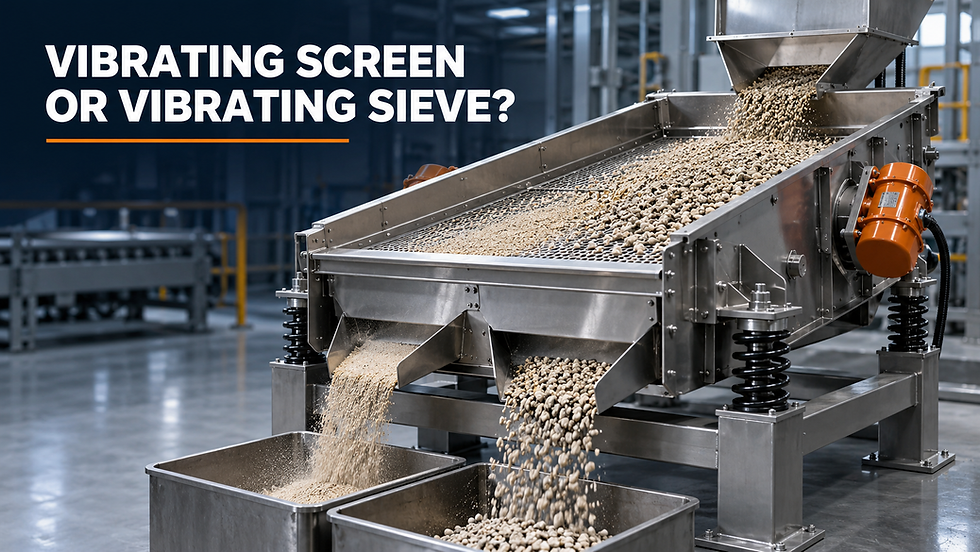
The material, required throughput, number of separations, moisture content, operating environment and cleaning requirements all influence the design. A machine that works well with dry granules may struggle with sticky powder, damp aggregate or delicate food product. Correct selection at the start can improve separation accuracy, reduce blockages and protect the rest of the production line.
What is the difference between a vibrating screen and a vibrating sieve?
The terms are sometimes used interchangeably, but they usually describe different duties.
A vibrating sieve is commonly used for finer products, safety screening and the removal of contamination or oversized particles. It may handle powders, food ingredients, chemicals, granules or pharmaceutical products. Hygiene, contained handling and easy cleaning are often important.
An industrial vibrating screen generally refers to a more robust machine used for higher capacities, heavier products or multiple size separations. Typical applications include aggregates, recycling, minerals, animal feed and general bulk-material processing.
The name alone does not determine the right design. The duty of the machine is what matters.
Start with the product
Before a screen can be specified, the material needs to be understood. Useful information includes:
bulk density
minimum and maximum particle size
required separation or cut size
moisture content
temperature
whether the product is abrasive, corrosive, fragile or sticky
the shape of the particles
expected feed rate
Two materials with the same nominal particle size can behave very differently. Rounded granules may travel and separate freely, while flat flakes can bridge across an opening. Damp powder can blind a mesh that handles the dry version without difficulty. Abrasive material may also require replaceable wear liners or a different screen surface.
A representative product sample and, where appropriate, a practical material trial can remove much of the uncertainty before manufacture begins.
Capacity and screening area
Throughput is not controlled by mesh size alone. The available screening area, depth of material on the deck, feed distribution and vibration pattern all contribute to performance.
If material arrives in one concentrated stream, part of the screen may be overloaded while the remaining area is underused. A correctly designed inlet or upstream vibrating feeder can spread the product more evenly across the deck. This gives particles more opportunity to contact the screen surface and find an opening.
Simply increasing vibration does not always increase capacity. Excessive acceleration can cause material to bounce without separating properly, increase wear or transmit unnecessary force into the supporting structure. The drive, springs, screen body and product load need to work as one system.
Choosing the screen surface
Woven wire mesh is widely used and is available in many aperture sizes and wire diameters. Perforated plate can offer a tougher surface for heavy or abrasive products. Wedge wire, polyurethane panels and other specialist surfaces may suit wet processing, dewatering or demanding wear conditions.
The open area of the screen surface is important. Two surfaces with the same aperture can have different open areas and therefore different capacities. A heavier wire may last longer, but it can reduce the space available for material to pass through.
The best choice balances separation accuracy, capacity, wear life, hygiene and replacement cost.
Single-deck or multi-deck screening
A single deck produces two material streams: particles that pass through the screen and particles that remain above it. A multi-deck machine can make several separations within one unit.
Multi-deck screening can save floor space, but each additional deck changes access, loading and maintenance requirements. It is important to define every required fraction clearly and allow suitable discharge arrangements for each one.
Preventing mesh blinding and product build-up
Blinding occurs when particles lodge in or cover the screen openings. It reduces usable area and can quickly affect both capacity and separation quality.
Possible solutions include changing the vibration pattern, adjusting the feed rate, selecting a different mesh geometry or introducing an appropriate cleaning system. The correct response depends on why the blockage is occurring. Applying more force without diagnosing the cause can shorten component life without solving the problem.
Construction, hygiene and containment
Mild steel is suitable for many dry industrial applications. Stainless steel may be preferred where equipment is washed down, exposed to corrosion or used for food, chemical and pharmaceutical products.
For hygienic duties, the design should minimise ledges, trapped material and difficult-to-clean joints. Covers, dust extraction points and sealed flexible connections may also be needed when the product creates airborne dust or must be protected from the surrounding environment.
These requirements should be considered during design rather than added after the machine has been built.
Why an engineered solution matters
A vibrating screen is a dynamic machine. Its performance depends on the relationship between mass, stiffness, drive speed, centrifugal force and the natural behaviour of the complete assembly. Changing the product load, motor settings or spring arrangement can change that behaviour.
This is why the screen body, supporting springs, vibrator motors, structural connections and controls should be specified together. Good fabrication is essential, but it must follow a sound mechanical design.
Talk to Spiral Elevator about your screening duty
Spiral Elevator designs and manufactures bespoke vibrating screens and vibrating sieves for industrial processing applications. By considering the product, capacity, cut size, available space and operating environment together, we can develop a machine around the actual process rather than forcing the process to suit a standard unit.
If you are planning a new screening stage or replacing equipment that is no longer performing reliably, send us your material information, target capacity and required separation. Our team can help you identify the most suitable approach.


Comments