top of page


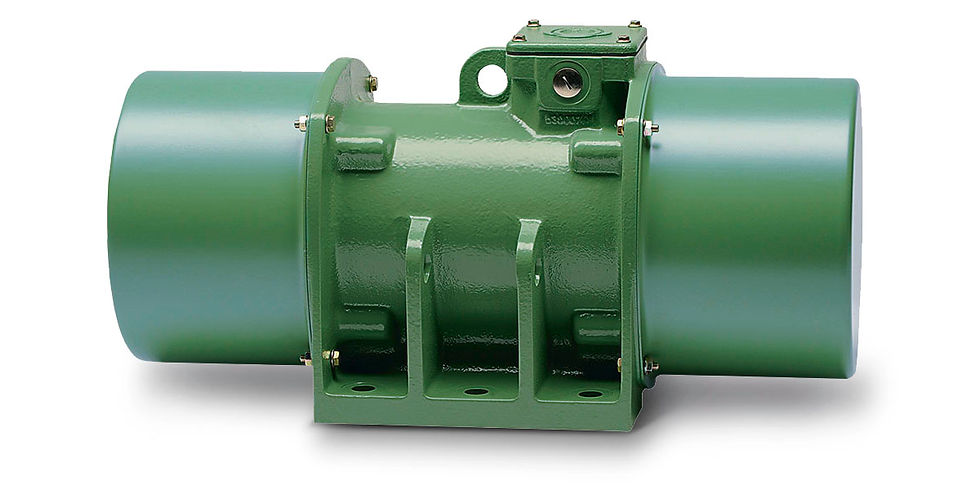
Need robust vibrator motors that deliver dependable performance in demanding industrial environments? Spiral Elevators Ltd supplies high-quality vibration motors engineered for efficient force output and long service life across feeders, screens, and material handling systems.
High-Performance Industrial Vibrator Motor Range



Vibratory Motors Frequently Asked Questions
A rotary electric vibrator motor turns eccentric masses that generate a rotating excitation force. Machine geometry, suspension and drive arrangement determine the resulting movement.
This differs from an electromagnetic feeder drive, which uses magnetic excitation through a spring-mounted assembly. We identify the actual drive type before selecting a replacement. Speed, centrifugal force, mass and mounting matter as well as power, because kilowatts alone do not describe the required vibration output.
Vibrator motors are used on feeders, screens, tables, hopper flow aids and spiral elevators, in arrangements selected for the required motion. A machine may have one motor or an engineered combination.
The same motor is not automatically suitable for every duty. We assess moving mass, speed, force and mounting, and whether the process needs conveying, separation or settling. Component selection follows that complete requirement.
Many rotary vibrator motors allow eccentric-mass adjustment within the manufacturer's instructions. This changes excitation force, but the setting must remain suitable for the machine.
Adjustments require safe isolation and competent personnel, following the instructions for motor ends and any paired arrangement. Increasing force to compensate for poor feeding may increase stress without solving the cause. Loading, mounting, suspension and the material should be checked before changing the setting.
We handle enquiries across different models, speeds and centrifugal-force ratings, with the exact specification and availability confirmed for the order.
Send the existing reference or required duty, mounting dimensions and electrical supply. Physical size and kilowatts are not enough. A larger motor adds mass and can change machine behaviour, so an upgrade is assessed rather than selected simply because it offers a higher maximum force.
Appropriate options can be assessed for dust, moisture, temperature and industrial service. Check protection and permissible conditions for the exact motor model.
An IP rating concerns ingress protection; it does not by itself establish corrosion resistance, chemical-cleaning compatibility or suitability for explosive atmospheres. Provide the environment and cleaning regime before ordering. Installation and maintenance must also follow the manufacturer's requirements.
We help identify replacement motors from the nameplate, mounting dimensions and application. Our range includes OLI, Vibtec, Invicta, Friedrich and JOEST, with model and availability confirmed individually.
For an alternative brand, we compare speed, force, mass, electrical rating and mounting rather than appearance alone. Where motors operate as a pair, compatibility must be assessed for the pair as well as the individual replacement.
We assess hazardous-area motor enquiries against the zone, substance, temperature limits, ambient conditions and electrical supply. The exact certificate, marking and any special conditions of use must suit the selected model.
An ATEX-rated motor does not establish compliance of the whole vibrating machine. The installation and machine need appropriate assessment, including mechanical ignition risks and interfaces. Provide the area requirements before a replacement or new motor is selected.
We can supply motor enquiries with UK delivery and technical selection assistance. Send the complete nameplate and mounting details to identify the required model or assess an alternative.
Our range includes OLI, Vibtec, Invicta, Friedrich and JOEST. Stock, lead time and delivery are confirmed for the particular variant. Our machine-design experience helps us consider what the motor needs to do, rather than select only by price or an apparently similar photograph.
Check speed or pole count, centrifugal force, electrical rating, bolt pattern and physical envelope. Mass, duty and environmental protection also need to suit the equipment.
Provide the complete manufacturer reference rather than a partial model number. For paired motors, state whether one or both are being replaced. Matching bolt holes and voltage alone does not establish that the proposed motor will reproduce the intended movement or loading.
Tell us which organisation and activity your quality requirements concern, and which certificate you need. We can then check the relevant available manufacturer or supplier documents for the proposed order.
ISO 9001 concerns a quality-management system within its certified scope, not the performance of an individual motor. Product conformity and hazardous-area certification are separate matters. We confirm the available documents rather than describe every motor as ISO certified.
Force is considered together with speed, moving mass and suspension. Mounting position influences how the excitation acts, while temperature, duty cycle and environment impose additional constraints.
We review the whole duty before proposing an alternative or larger motor. More force may increase structural loading without curing a flow problem. The selected component should suit the intended dynamics and machine capability, not merely a target power rating.
We assess selection using moving mass, loaded conditions, suspension and the required motion. A feeder, screen and compaction table may need different responses at similar overall weights.
Drawings, existing motor references and operating information help with replacements. New or modified machines may require structural and dynamic assessment. We do not size from throughput or weight alone and assume the rest of the design will automatically work.
Selection follows required speed and excitation, loaded mass, operating hours and starting and stopping conditions. Supply and environment are specified too.
We identify a suitable model and explain differences from the existing arrangement. Changing speed, force or mass can alter both performance and structural loading. This is why a proposed equivalent motor needs a full specification check instead of being accepted because its dimensions and power look close.
We help identify the motor and review suitability for the stated application. Instructions for the exact model establish its installation, connection, adjustment and maintenance requirements.
Additional troubleshooting or support can be discussed, with scope confirmed for the order. Competent personnel should carry out installation and checks. A component purchase does not automatically include redesign of the whole machine or unrestricted site attendance unless those services are expressly agreed.
We assess replacement motors and compatible controls using the machine, supply and required operating range. Rotary motors and electromagnetic drives need different control approaches.
For variable-frequency operation, the permitted motor and machine range must be established. Stopping, protection and line interfaces also need review. Similar power ratings do not make controllers interchangeable, so we check the actual drive and operating requirements before recommending the arrangement.
The drive supplies excitation, while geometry and suspension turn it into useful movement. Conveying requires controlled travel, screening needs suitable deck presentation, and compaction needs motion transmitted through the loaded container.
Rotary motors and electromagnetic drives generate excitation differently. We choose the arrangement for the process instead of treating all vibration as interchangeable. Loading and controls remain part of the design, because the drive alone does not determine reliable feeding, separation or settling.
Our published range includes OLI, Vibtec, Invicta, Friedrich and JOEST vibrator motors. We also supply ROSTA oscillating mounts and OLI OWS mounts, which are suspension components rather than motor brands.
For a quotation, we identify the exact model and configuration. Brand alone is not enough to establish suitability, and catalogue availability should not be confused with every model being immediately available from stock.
Send the reference and application details so the proposed supply can be checked properly.
Our business includes designing the machines that vibrator motors drive, as well as supplying the motors themselves.
That allows the discussion to go beyond price and delivery. We can consider what the motor is being asked to do, whether the machine's performance has changed and whether a proposed replacement addresses the actual problem.
We want to help you select a suitable component, not simply sell a motor that appears similar in a photograph.
We can assess an alternative, but matching the mounting holes is only the beginning.
The comparison also needs to address rotational speed, vibration output, motor mass, mounting arrangement and the specified operating environment. Manufacturer ranges include different speeds and mounting configurations, even within the same brand.
For a machine using a matched pair of counter-rotating motors, we also need to consider the pair as a system. A replacement should not be approved solely because one motor bolts into the available space.
The kilowatt rating does not describe the complete vibration output. Vibrator motors are also selected by characteristics including speed and centrifugal force, and manufacturers offer different combinations across their ranges.
For example, a four-pole motor and a six-pole motor operate at different speeds on the same supply frequency. Selecting one in place of the other changes the excitation frequency, even when their power ratings appear similar.
We therefore check the complete specification rather than treating equal power as proof of equivalence.
Send a clear photograph of the complete nameplate, the model reference, photographs of the installed motor and the mounting dimensions where available.
Include the supply voltage and frequency, whether the machine uses one or two motors, and the reason for replacement. It is useful to know whether the motor has failed completely, is overheating, or whether the equipment has gradually lost performance.
We would confirm the proposed model, availability and any differences before you commit to an alternative. That is preferable to discovering an incompatibility during installation.
Only where the exact motor rating and intended application permit it. Changing supply frequency changes rotational speed, and manufacturers publish different speed figures for 50 Hz and 60 Hz operation.
For an overseas order, we check the nameplate requirements and destination supply rather than assuming that a UK-specified motor is suitable everywhere.
The machine duty also needs reviewing. Electrical compatibility alone does not establish that the equipment will produce the required movement or process performance.
Suitable vibrator motors can be operated with a variable-frequency drive; OLI, for example, identifies inverter compatibility within its MVE range.
However, that does not mean every vibrating machine should run across an unrestricted frequency range. Our proposal would need to establish the permitted operating range and suitable starting, stopping and protection arrangements for the complete machine.
Tell us whether you need occasional adjustment, automatic process control or frequent stopping and starting. Those are different operating requirements and should be considered during selection.
bottom of page